
Why this question still matters in 2026
After three decades in technology, you’ve likely seen the same pattern repeat:
Every abstraction promises simplicity – until scale, cost, or control exposes the trade-offs.
AWS Lambda and containers are not competing technologies.
They are different execution models, optimized for different failure domains, cost curves, and operational responsibilities.
The mistake organizations make is not choosing the wrong tool, but standardizing too early.
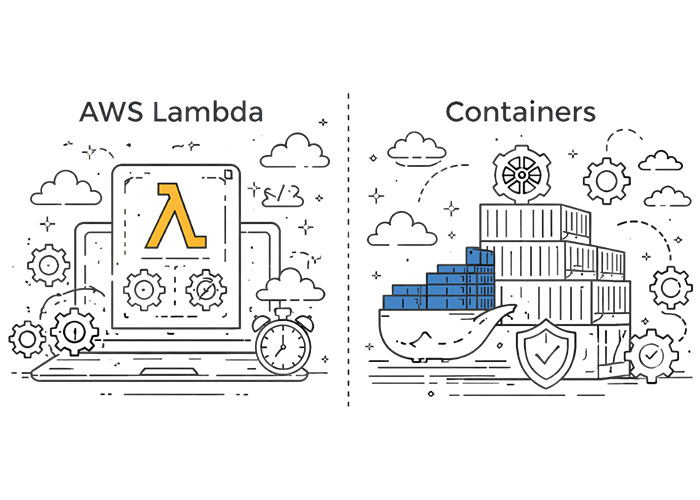
What AWS Lambda really is
AWS Lambda is:
- Event-driven
- Ephemeral by design
- Billed per millisecond of execution
- A fully managed execution environment
What Lambda removes:
- Server provisioning
- Capacity planning
- OS patching
- Runtime lifecycle management
What Lambda does not remove
- Cold starts
- Architecture decisions
- Dependency size constraints
- Debugging complexity at scale
Lambda is not “simpler compute”, It is an outsourced operational discipline.
What containers really give youSolution
Containers (via Amazon ECS or Amazon EKS) give you:
- Predictable runtime behavior
- Long-lived processes
- Full control over networking, memory, and CPU
- Easier stateful or streaming workloads
But they also give you:
- Scaling logic
- Patch management
- Capacity planning responsibility
- Failure domain design
Containers don’t reduce work. They move work closer to engineering – where experienced teams often prefer it.
A leadership-level comparison
| Dimension | AWS Lambda | Containers |
|---|---|---|
| Scaling | Automatic, instant | Explicit, controlled |
| Cost Model | Per execution | Per allocated capacity |
| Startup Latency | Cold starts possible | Always warm |
| Runtime Limits | Hard limits (time, size) | Flexible |
| Operational Control | Minimal | High |
| Best For | Event-driven spikes | Long-running systems |
When Lambda is the right decision
Choose Lambda when:
- Workloads are sporadic or bursty
- Execution time is short and predictable
- You want minimum operational overhead
- Failures should be isolated per request
Strong examples
- API request handlers
- S3 event processing
- Authentication hooks
- Lightweight ETL steps
Lambda shines where idleness is common.

When containers is the right decision
Choose containers when:
- Workloads are long-running
- You need predictable latency
- You manage connections, streams, or state
- You want consistent behavior across environments
Strong examples
- Background workers
- Streaming consumers
- ML inference services
- Internal platforms
Containers shine where control matters more than convenience.

A simple real-world example
Lambda




Containers




Correct architecture


Not either/or. Both – used intentionally.
The executive takeaway
Lambda optimizes for velocity and cost at low utilization. Containers optimize for predictability and control at scale.
“Tools enable progress. Decisions determine outcomes.”
We Can Handle
Your Idea
Write an email or a message, tell us your story and we will come up with the best solution for your future robust product